Finding a Jain tiffin service is harder than finding a vegetarian one. “Veg” on a menu card usually still means potatoes, onions, and garlic, and a kitchen that says “we can make it Jain” often means it will skip the onion and leave everything else as it was. If you keep a Jain diet at home and have moved to a hostel, a new city, or abroad, this guide explains what a proper Jain tiffin should look like, the questions that separate kitchens that understand the diet from those that are guessing, what a weekly menu can realistically include, and how to find one near you.
What a Jain diet actually means for a tiffin
Jain food is built on ahimsa, the principle of not harming living beings, including the smallest ones. For a kitchen cooking your daily meal, that turns into a short list of hard rules and a few that vary by family.
The non-negotiables
- No root vegetables: potato, onion, garlic, carrot, radish, beetroot, ginger (fresh), turmeric root, and lotus stem are all out. Dried ginger and turmeric powder are accepted by most families.
- No eggs, meat, or fish, and no honey for most families.
- Nothing cooked the previous day. Food cooked today is eaten today.
- Fresh curd only: set the same day, never sour or overnight.
Rules that vary by family
- Brinjal, cauliflower, cabbage, broccoli, and mushrooms are avoided in stricter households because they can harbour small organisms.
- Fermented batters (dosa, idli, dhokla) are avoided by some; others accept quick-set versions made the same morning.
- Chauvihar: many families do not eat after sunset, so a dinner tiffin needs to arrive early, typically by 6 pm in winter.
- Paryushan and Chaturmas: during these periods green leafy vegetables are also dropped, and some families reduce to one meal a day.
A kitchen worth subscribing to will ask which of these apply to you before the trial, not after a complaint.
How to tell a real Jain kitchen from a “no onion” kitchen
This is where most people get caught. The cook is well-meaning, the food is vegetarian, and yet the potato sabzi arrives on day two. Ask these questions before paying for a month.
Is the kitchen fully Jain, or does it cook Jain on request?
A kitchen that cooks only Jain food has no onion or garlic in the house, no shared kadhai, and no chance of a mix-up on a busy day. A kitchen that cooks Jain on request can still be excellent, but ask how they separate utensils, oil, and prep surfaces.
What do they use instead of onion and garlic?
The right answer is asafoetida (hing), cumin, green chilli, tomato, dried mango powder, coriander, and a confident hand with whole spices. If the answer is “we just leave the onion out”, the gravies will be thin and the menu will get boring fast.
What is in the dal and the sabzi on a normal Tuesday?
Ask for the actual weekly menu. A kitchen that understands the diet will list things like dudhi (lauki), tindora, parwal, bhindi, guvar, chawli, methi, karela, kadhi, moong dal, and a dozen other things that have nothing to do with potatoes.
When does dinner arrive?
If you follow chauvihar, this is the deciding question. The tiffin must reach you well before sunset, which in most of India means a 5 to 6 pm delivery window, not 8 pm.
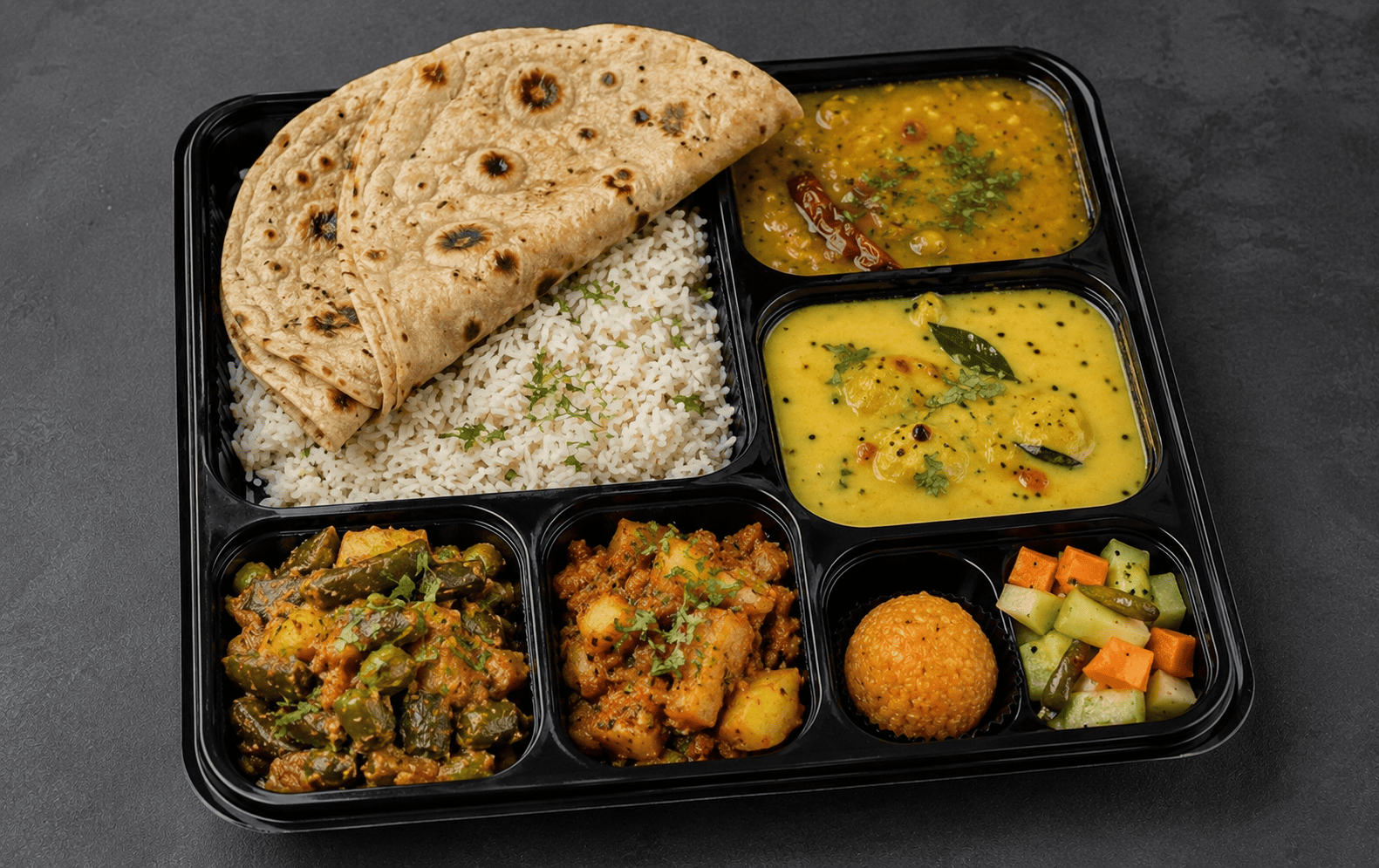
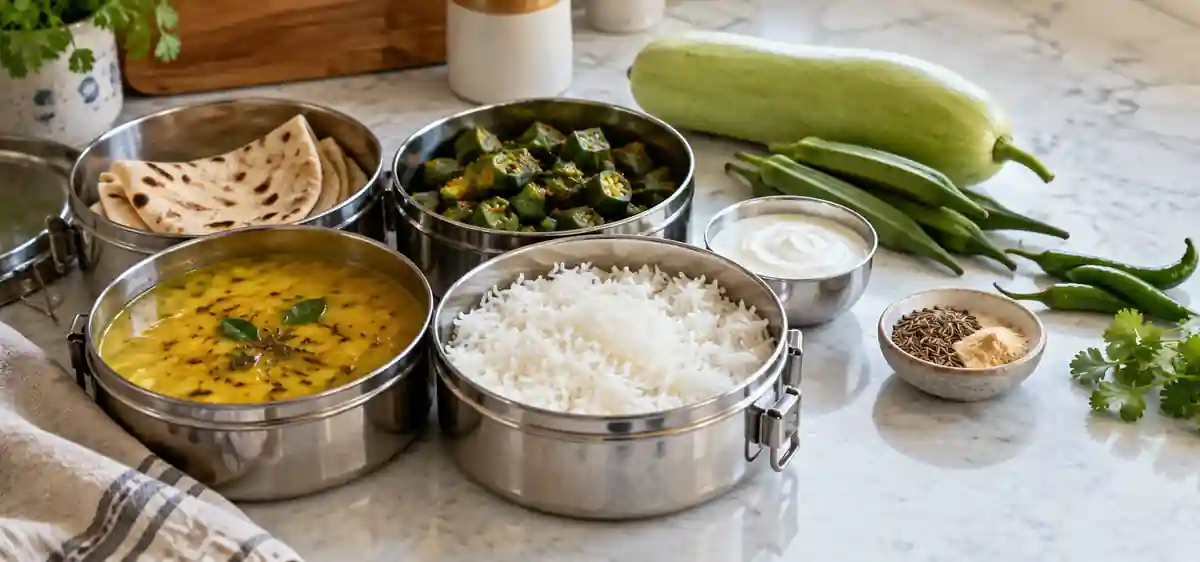
A typical Jain tiffin: dal, a gourd-or-greens sabzi, rotli, rice and same-day curd, seasoned with hing and cumin instead of onion and garlic.
What a week of Jain tiffin can look like
People worry a Jain tiffin will be repetitive. It does not have to be. Here is the kind of rotation a good Gujarati or Marwari Jain home kitchen runs, built entirely without root vegetables.
| DayDal / kadhiSabziBaseExtra | ||||
| Monday | Gujarati toor dal | Bhindi masala | Rotli + rice | Fresh curd |
| Tuesday | Moong dal tadka | Dudhi chana | Rotli + rice | Papad, pickle |
| Wednesday | Gujarati kadhi | Tindora or parwal | Rotli + khichdi | Chhundo |
| Thursday | Dal dhokli | Methi thepla + sev tameta | — | Fresh chaas |
| Friday | Panchmel dal | Guvar dhokli | Rotli + rice | Shrikhand (small) |
| Saturday | Chana dal | Paneer in tomato gravy | Rotli + jeera rice | Salad |
Swap in Marwari, Punjabi, or South Indian Jain dishes depending on the kitchen. The structure is what matters: a dal or kadhi, a sabzi built on gourds, beans, or leafy greens, a base, and something fresh.
Jain tiffin for students and people working away from home
The single most common Jain tiffin customer is a student in a hostel mess that cannot cook Jain, or a young professional in a city where restaurant “Jain” means a cheese pizza with no onion. A tiffin service solves both.
For hostel and PG residents
Ask the kitchen to deliver to the hostel gate at a fixed time and, if you follow chauvihar, to combine lunch and an early dinner into one delivery when needed. Many Jain kitchens near universities already run exactly this schedule.
For Jain families abroad
In Canada, the US, the UK, and the Gulf, Jain home kitchens exist in most cities with a Gujarati or Marwari community, but they are hard to find through mainstream food apps. They often work on a weekly plan with two deliveries, and some cook Paryushan-period menus on request.
For festival periods
Ask in advance whether the kitchen runs a Paryushan menu (no leafy greens) and whether it can do a single early meal a day during that week. Kitchens that offer this understand the diet properly.
Typical cost of a Jain tiffin service
Jain tiffins cost slightly more than standard veg tiffins because the ingredient list is narrower and more seasonal, and because the kitchen is usually smaller and cooks in smaller batches. These are planning ranges for Indian cities, not quotes.
| PlanPer mealMonthly (26 days) | ||
| Jain lunch or dinner, one meal | ₹120 – ₹180 | ₹3,000 – ₹4,700 |
| Two meals a day | ₹110 – ₹170 each | ₹5,500 – ₹8,500 |
| Weekly trial (6 days, one meal) | ₹130 – ₹200 | ₹800 – ₹1,200 |
Finding a Jain tiffin service near you
The traditional route is the local derasar notice board or a community WhatsApp group, and that still works well. TiffinWorld adds a way to compare: home kitchens list their cuisine, dietary type, and weekly plans by locality, so you can shortlist Jain kitchens near you without messaging ten numbers.
Filter by Jain in categories
Open the categories page, choose Jain, and narrow by your pincode. Kitchens that cook Jain on request are usually marked separately from fully Jain kitchens.
Check the menu before you message
On the menu page, each kitchen shows its weekly dishes, so you can see at a glance whether the sabzis are gourds and greens or whether aloo is sneaking in.
Send one inquiry with your rules
Put your pincode, whether you follow chauvihar, and any family-specific rules (no brinjal, no fermented batter) in the inquiry. The kitchen replies to you directly and can confirm before you commit.
Frequently asked questions
What is a Jain tiffin?
A daily home-cooked meal prepared without root vegetables (potato, onion, garlic, carrot, and others), eggs, meat, or fish, cooked fresh the same day, and often delivered before sunset for families that follow chauvihar.
Is Jain food the same as “no onion no garlic”?
No. No onion no garlic is a subset. Jain food also excludes potatoes and all other root vegetables, and most families avoid stale or overnight-fermented food.
Can a Jain tiffin include paneer and curd?
Yes, for most families. Dairy is accepted as long as curd is set fresh the same day. A small number of Jains follow a vegan diet; tell the kitchen if that applies to you.
Do Jain tiffin services deliver before sunset?
Kitchens that serve Jain customers regularly do. Confirm the exact dinner window, especially in winter when sunset is earlier.
Can I get a Paryushan menu?
Many Jain home kitchens run a special menu without green leafy vegetables during Paryushan and can do a single early meal a day. Ask before the period starts.
How much does a Jain tiffin cost?
Roughly ₹120 to ₹180 per meal in most Indian cities, or ₹3,000 to ₹4,700 a month for one meal a day. Prices vary by city and kitchen.
Eat the way you eat at home
You should not have to explain your diet to a new cook every month. Find Jain home kitchens near you on TiffinWorld, compare their weekly menus, and send a trial inquiry with your rules. If you run a Jain kitchen, list it on TiffinWorld so families and students in your area can find you. And if you want a general checklist first, read how to choose a tiffin service near you.